

.png?width=600&height=408&name=march%202023%20-%20french%20toast%20(1).png)
.png?width=1080&height=1080&name=Bold%20Metrics%E2%80%99%20digital%20twin%20technology%20helps%20some%20of%20the%20worlds%20biggest%20bands%20increase%20conversion%20and%20AOV%2c%20reduce%20returns%2c%20optimize%20their%20customer%20experience%2c%20and%20boost%20brand%20loyalty.%20(2).png)


Fix Apparel Sizing Data Fragmentation in 2026
Published by
Bold Metrics
on
When a shopper browses your website, adds an item to cart, and then abandons it because they aren't sure which size to order, that hesitation rarely comes from indecision. It comes from experience. They've been burned before by inconsistent sizing across brands, across channels, and across your own product lines.
The root cause isn't a technology gap. It's data fragmentation, with sizing information scattered across ecommerce platforms, ERP systems, PLM solutions, and POS channels with no unified structure connecting them. In 2025, U.S. retailers received approximately $743 billion in returned merchandise, representing 14.5% of all purchases. [1] Online returns run even higher, and apparel leads all categories. Bold Metrics helps apparel brands unify this fragmented sizing data through AI-powered digital twin technology, turning disconnected data points into accurate fit recommendations that reduce returns and build shopper confidence.
This guide walks you through the mechanics of sizing data fragmentation, why it happens, what it costs your business, and how to build an integrated fit data infrastructure that works across every channel where your customers shop.
Key Takeaways: Fix Apparel Sizing Data Fragmentation in 2026
Sizing data fragmentation drives up to 70% of apparel returns, costing brands roughly $30 per returned item in fully loaded expenses. U.S. retailers processed $743 billion in returned merchandise in 2025; apparel carries the highest return rate of any ecommerce category at around 24–26%. Most brands publish size charts without telling shoppers whether the measurements refer to their body or the finished garment, a silent source of confusion that drives returns. Cross-platform data silos prevent fit recommendations from working consistently across ecommerce, marketplaces, and conversational AI channels. Digital twin technology creates a unified body data layer that standardizes sizing intelligence across all retail touchpoints. Bold Metrics' AI body modeling generates 50+ body measurements from just 4–6 simple shopper inputs, enabling accurate fit recommendations without photos or intrusive data collection. Brands that unify their sizing data infrastructure see measurable improvements in conversion rates, average order value, and return reduction.
What Is Sizing Data Fragmentation in Apparel Retail?
Sizing data fragmentation occurs when your fit and measurement information exists in disconnected systems that don't communicate with each other. Your product information management (PIM) system stores a single set of garment specs. Your ecommerce platform displays a different size chart. Your marketplace listings use yet another format. And your technical design team works from patterns that may not align with any of these.
The result is inconsistency at every customer touchpoint. A shopper who wears a Medium in one of your styles discovers they need a Large in another. The same customer finds conflicting size recommendations on your website versus a marketplace listing. This inconsistency erodes trust and drives returns.
Research consistently shows that up to 70% of apparel returns stem from size and fit issues. [2] The underlying cause isn't that customers don't know their size — it's that your sizing data doesn't give them a reliable way to find it.
Why Does Sizing Data Become Fragmented Across Platforms?
Understanding how fragmentation happens is the first step toward fixing it. Most apparel brands don't set out to create disconnected data systems. Fragmentation accumulates gradually as your business grows and your technology stack expands, and it often starts before you even think about channels or systems, at the most basic level: the size chart itself.
The Body Measurement vs. Garment Measurement Divide
Most apparel size charts fall into one of two categories, and most brands never tell shoppers which one they're looking at.
Body measurement charts tell the shopper what physical dimensions correspond to each size. A body measurement chart for a Medium might read: chest 38–40 inches, waist 32–34 inches. The shopper needs to measure themselves and match their measurements to the chart.
Garment measurement charts show the actual dimensions of the finished garment laid flat. The same Medium, measured at the garment level, might read: chest width 21 inches (42 inches when doubled), body length 28 inches. These are construction specs, not body guides — and interpreting them requires understanding wearing ease and fit allowances that most shoppers simply don't know.
The problem compounds when brands don't label which type they're using. Consider three real examples:
• Sporty & Rich publishes a size chart on product pages but doesn't specify whether the measurements refer to the shopper's body or the finished garment. It's almost certainly body measurements, but a shopper who doesn't already know that has no way to be sure. That ambiguity alone is enough to kill a conversion.
• Iron Heart lists only garment measurements without labeling them as such. Shoppers see larger numbers than they expect for their size and either size down incorrectly or abandon the purchase. The information is accurate; it's just presented without the context needed to use it.
• Wool & Prince represents a better approach:: they publish both body and garment measurements side by side and clearly label each column. Shoppers get exactly what they need to make a confident decision, regardless of how they prefer to shop for fit.
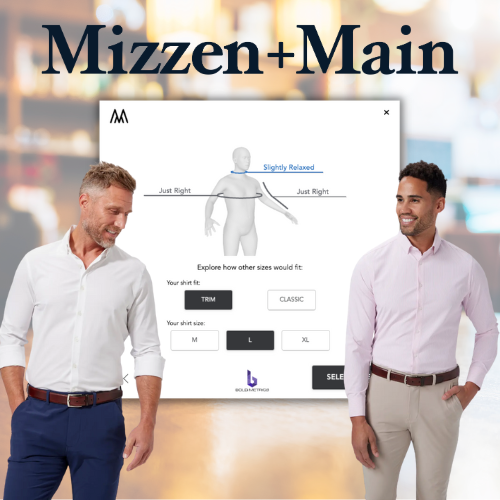
•Mizzen + Main is the gold standard: Traditional size charts are built on assumptions: that a given size represents consistent proportions across all body types, and that shoppers already know their measurements. The Smart Size Chart™ works differently. Shoppers enter just four to six simple inputs, and Bold Metrics' AI instantly generates 50+ body measurements, creating a detailed digital twin of each shopper. That digital twin is then mapped against Mizzen+Main's actual garment construction data to evaluate how a specific shirt or pant will fit at key points such as the chest, waist, hip, and sleeve length.
The results were immediate:
20% conversion rate among Smart Size Chart™ users
19% higher average order value for users vs. non-users
78% completion rate among shoppers who clicked "Find My Size"
These aren't just metrics. They reflect what happens when shoppers buy with confidence and what's possible when a size recommendation is built on real body data and real garment specs, not industry averages.
Most brands fall somewhere between the Sporty & Rich and Iron Heart approaches: one measurement type, unlabeled, with no guidance on how to use it. And when a shopper moves from one brand to another, the type may switch without any indication. A shopper who learned to navigate body measurement charts will misread garment measurements, and vice versa. This is sizing data fragmentation at its most fundamental: inconsistency that exists within a single brand's PDP, before you've even introduced channels, marketplaces, or AI agents into the picture.
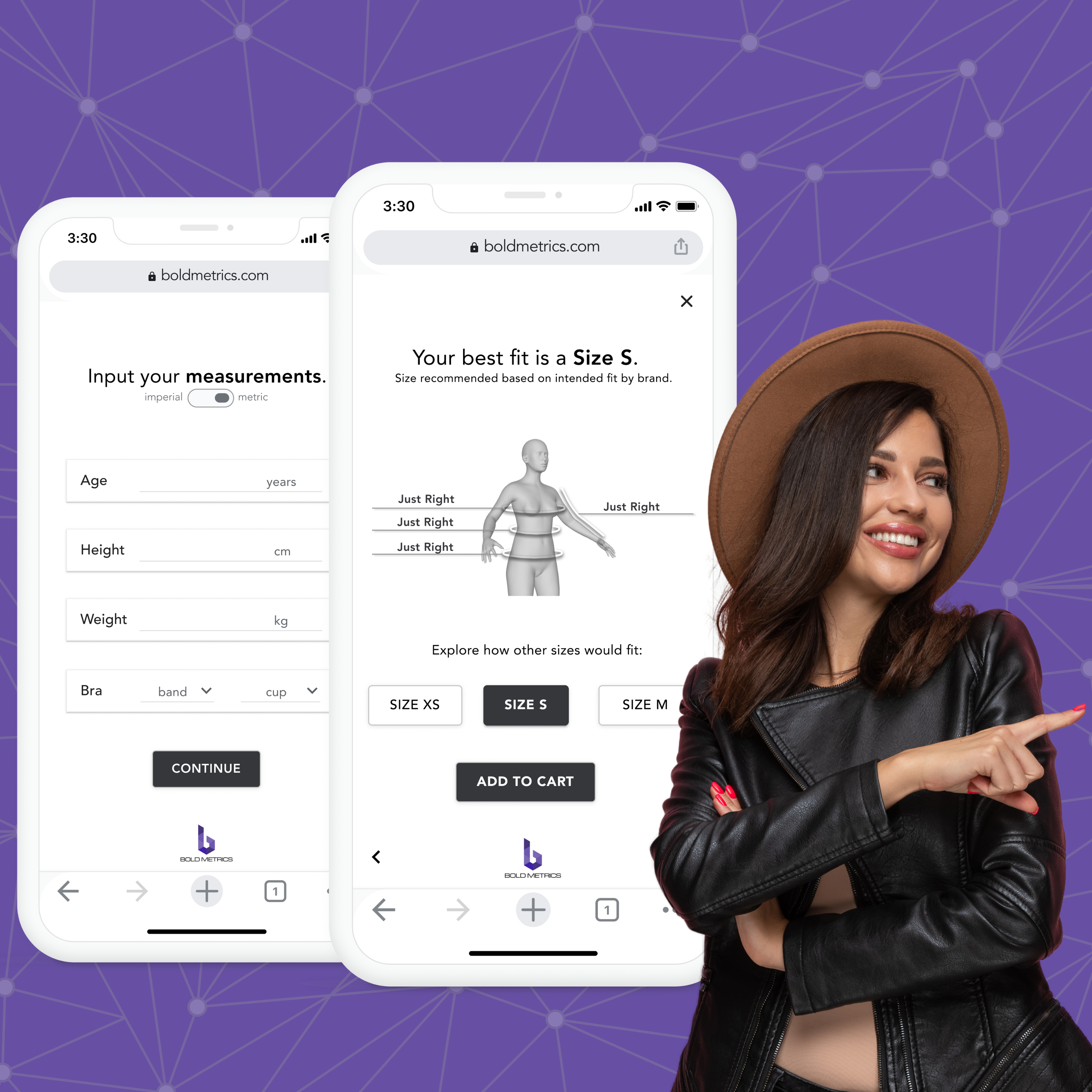
Bold Metrics eliminates this ambiguity entirely. Rather than asking shoppers to interpret measurement tables of either type, the Smart Size Chart™ and Virtual Sizer™ accept simple inputs of height, weight, and age and translate them directly into a personalized size recommendation for each specific garment. The shopper never needs to know whether the brand uses body or garment measurements, because the Virtual Tailor™ body modeling engine resolves that complexity behind the scenes.
Legacy Systems and Organic Growth
Many brands start with basic size charts built manually in spreadsheets. As you add products, categories, and channels, these charts multiply. Your women's line has one chart. Your men's line has another. Your kids' collection uses a third format entirely. Without a centralized sizing data architecture, each product line develops its own sizing language.
When you launch on a new marketplace or expand internationally, you often adapt sizing data to meet platform requirements. These adaptations create divergence. Over time, your original size chart bears little resemblance to what appears on Amazon, Zalando, or your own mobile experience.
Siloed Teams and Disconnected Workflows
Technical designers define fit specifications during product development. Merchandising teams translate those specs into customer-facing size charts. Ecommerce managers upload that information to your website. Marketplace teams reformat it for external channels. Each handoff introduces opportunities for error and drift.
When these teams work from different source files or from no source file at all, sizing data becomes inconsistent. A small change in one system doesn't propagate to others. Your PDP says one thing while your returns data tells a different story.
The Rise of Conversational Commerce
AI shopping agents and conversational commerce platforms add another layer of complexity. These systems pull sizing information from structured data, product descriptions, and customer reviews. If your sizing data lacks consistency and structure — or mixes unlabeled body and garment measurements — AI agents can't reliably recommend the right size to shoppers.
Gartner projects that by 2028, 15% of day-to-day work decisions will be made autonomously by agentic AI. [3] In apparel, that means AI agents will select and purchase products on consumers' behalf, and brands without structured, consistently labeled sizing data will be invisible to them.
What Does Sizing Data Fragmentation Cost Your Business?
Fragmented sizing data isn't just an operational inconvenience. It directly impacts your bottom line through returns, lost sales, and diminished customer lifetime value.
The True Cost of Size-Related Returns
Apparel carries the highest return rate of any ecommerce category. Overall online return rates run around 17.6% [1], but within specific apparel categories, the numbers climb sharply: shoes at roughly 30–35%, women's fashion at about 28%, and dresses at 33–38%.
The fully loaded cost of processing a single apparel return, including reverse shipping, 3PL receiving, inspection, restocking, markdown on returned units, and customer service overhead. [4] When 53–67% of those returns trace back to size and fit issues, the math becomes stark. On a $55 garment, you're losing half to two-thirds of the item's value to returns that accurate sizing data could have prevented.
Scaled up: a brand doing $50 million in annual revenue, with a 25% return rate and 60% of those fit-related, is incurring roughly $2.2 million per year in avoidable return-processing costs.
Conversion Loss from Sizing Uncertainty
Returns represent orders that happened. But fragmented sizing data also prevents orders from happening in the first place. The Baymard Institute's meta-analysis of 44+ studies found an average cart abandonment rate of 70.19% across ecommerce, [5] with sizing uncertainty consistently cited as one of the top reasons shoppers walk away from apparel purchases.
When shoppers can't confidently determine their size, whether because they don't know if they're reading a body or garment measurement chart, or because the size chart conflicts with another channel, they don't buy. Or they bracket, ordering multiple sizes with the intention of returning the ones that don't fit. According to the NRF, approximately 36% of online shoppers have deliberately ordered multiple sizes or colors of the same item intending to return some. [1] A customer who orders three sizes of a $60 dress keeps one and returns two, generating $180 in revenue but leaving you with $60 net and $60 in returns processing costs.
Erosion of Customer Trust and Lifetime Value
Every poor-fit experience damages your relationship with that customer. Narvar's Consumer Report found that 96% of consumers would shop with a retailer again if the returns experience was positive — and the same holds for difficult experiences. [6] Separately, research from Oracle Retail found that 81% of consumers say they lose trust in a brand after receiving an item that doesn't match the description, including fit expectations. [7]
Sizing inconsistency creates difficult experiences. When a customer receives an item that doesn't fit as expected, they question your size chart, your product quality, and whether they should order from you again. That erosion of trust compounds over the customer's lifetime.
How Do You Audit Your Current Sizing Data Infrastructure?
Before you can fix fragmentation, you need to understand where it exists in your systems. A thorough sizing data audit reveals the gaps, inconsistencies, and opportunities in your current infrastructure.
Map Your Data Sources and Flows
Start by documenting every system that touches sizing data in your organization. This typically includes your PLM (product lifecycle management) system, PIM (product information management) platform, ecommerce CMS, marketplace integrations, ERP, and any standalone size chart experiences.
For each system, identify what sizing data it contains, whether it represents body or garment measurements, where that data originates, how frequently it updates, and what format it uses. Look for discrepancies between systems, and especially for unlabeled measurement types that could confuse shoppers right now.
Analyze Your Returns Data
Your returns data contains valuable signals about where sizing fragmentation causes the most pain. Examine return reason codes by SKU, category, and channel. Which products have the highest fit-related return rates? Which channels generate the most size complaints?
If your returns data lacks granular reason codes, that's a gap to address immediately. Generic "didn't fit" codes don't tell you whether the item ran large, ran small, or had inconsistent proportions, or whether the shopper misread a garment measurement chart as a body measurement chart. Detailed reason codes enable you to diagnose specific sizing problems and measure improvement over time.
Test Cross Channel Consistency
Shop your own brand across channels as a customer would. Compare the sizing information and fit recommendations you receive on your website, on your mobile experience, in your marketplace listings, and from any AI shopping agents that feature your products.
Document inconsistencies. A Medium on your website should mean the same thing as a Medium on Amazon. Your size chart type (body or garment) should be clearly labeled and consistent across every touchpoint. Any divergence represents fragmentation that confuses customers and drives returns.
What Is a Unified Fit Data Infrastructure?
A unified fit data infrastructure centralizes all your sizing information into a single source of truth that consistently feeds every customer touchpoint. Instead of maintaining separate size charts for each channel — or leaving shoppers to guess whether they're reading body or garment measurements, you maintain one authoritative data layer that propagates everywhere.
Structured Data for AI Interoperability
As AI shopping agents and conversational commerce grow, your sizing data needs to be structured for machine readability. This means using consistent schemas, clear measurement definitions, standardized fit descriptors, and explicit labeling of whether measurements are body- or garment-based.
Fragmented sizing data confuses AI agents just as it confuses human shoppers. When your product descriptions mix unlabeled body and garment measurements, or use inconsistent terminology "runs small" in one listing, "order one size up" in another AI systems can't synthesize reliable recommendations. McKinsey's State of Fashion 2025 report identifies AI-powered personalization, including fit and sizing, as one of the top technology investment priorities for apparel brands in the coming year. [8]
How Do You Implement Cross-Platform Sizing Data Integration?
Moving from fragmented to unified sizing data requires both technical integration and organizational alignment. Here's a practical framework for implementation.
Establish a Single Source of Truth
Designate one system as your authoritative source for all sizing data. This might be your PIM, a dedicated sizing platform, or a specialized fit intelligence solution like Bold Metrics. Every other system should pull sizing data from this source rather than maintain its own version.
Your source of truth should contain complete garment specifications, including flat measurements, intended fit (slim, regular, relaxed), size range, and any style-specific fit notes. It should also clearly indicate whether published measurements are body- or garment-based and define your size-naming conventions so that all downstream systems use consistent terminology.
Build Integration Pipelines
Create automated data flows from your source of truth to every channel. This includes API integrations with your ecommerce platform, data feeds to marketplaces, and structured outputs for AI systems and conversational commerce platforms.
Automation is essential. Manual data entry creates opportunities for error and drift. When your source system updates, those updates should propagate automatically to all downstream channels. This ensures consistency and reduces the operational burden of maintaining multiple size charts.
Implement Change Management Controls
Establish governance processes that prevent unauthorized modifications to sizing data in downstream systems. Define who can make changes, how those changes are approved, and how they propagate through your infrastructure.
Without governance, fragmentation will recur. Someone will manually adjust a size chart to fix a perceived problem, creating a new inconsistency. Clear ownership and change controls maintain the integrity of your unified data layer over time.
How Does AI Body Modeling Solve Sizing Inconsistency?
Traditional size charts ask customers to match their measurements against static tables — and as we've seen, those tables may represent body measurements, garment measurements, or some unlabeled combination of both. This approach fails for multiple reasons: most shoppers don't know their measurements, most size charts don't account for body-shape variation or fit preferences, and most brands don't even clarify what their numbers mean.
From Static Charts to Dynamic Recommendations
AI body modeling takes a fundamentally different approach. Instead of presenting a measurement table and hoping customers interpret it correctly, AI generates personalized fit recommendations based on individual body data, abstracting away the body-versus-garment measurement complexity entirely.
Bold Metrics' Virtual Tailor™ asks shoppers a few simple questions, typically height, weight, age, and body shape preferences. Proprietary algorithms trained on billions of data points translate those inputs into a complete body measurement profile with tailor-grade accuracy. That body data then surfaces through the Smart Size Chart™ or Virtual Sizer™ to deliver a personalized size recommendation that reflects how this specific item will fit each individual shopper.
Capturing First-Party Body Data at Scale
Every shopper interaction with your sizing experience generates valuable first-party data. Eighty-three percent of consumers are willing to share their data to receive a more personalized shopping experience, and accurate size recommendations are among the most tangible forms of personalization. [9]
Bold Metrics' Apparel Insights® platform unlocks this body data to optimize your entire operation, from design through distribution. The same unified data layer that improves fit recommendations also improves merchandise planning, size grading decisions, and inventory allocation.
What Results Can You Expect from Unified Sizing Data?
Brands that invest in unified fit data infrastructure see measurable improvements across key performance metrics. Here's what the data shows.
Return Rate Reduction
Accurate fit recommendations directly reduce size-related returns. Bold Metrics customers have documented return rate reductions averaging 32% across the platform, with brands like Canada Goose achieving a 21% reduction. Given that the NRF estimates the cost of processing returns at roughly $29.50 per item [4], a 32% reduction in returns for a brand processing 100,000 returns per year represents approximately $944,000 in recovered operating costs annually.
Even a 10% improvement in return rates is material. For a $30 million revenue apparel brand with a 25% return rate, that's 750,000 returned items annually. A 10% reduction eliminates 75,000 returns and saves over $2.2 million in processing costs.
Conversion Rate and AOV Improvement
Sizing confidence drives conversion. When shoppers trust your size recommendations, they complete purchases rather than abandoning carts. Forty-nine percent of consumers check a retailer's return policy before making a purchase, [6] signaling that fit uncertainty is already a friction point before checkout. Remove that friction and the impact is immediate.
Bold Metrics has documented conversion rate improvements of 4x on average among Smart Size Chart™ users compared to non-users, as well as average order value increases of up to 27%. Confident shoppers add more items to their cart rather than hedging with multiple sizes of one product.
Customer Satisfaction and Loyalty
Beyond immediate metrics, unified sizing data builds lasting customer relationships. Shoppers who receive items that fit as expected develop trust in your brand. Narvar's Consumer Report found that 96% of consumers would shop with a retailer again following a positive returns experience [6], and the most powerful path to eliminating difficult returns is getting the size right the first time.
Bold Metrics has generated 250 million+ digital twins across its platform, a scale that drives the accuracy and consistency brands need to build that confidence at every touchpoint.
How Do You Future-Proof Your Sizing Data for Agentic Commerce?
The rise of AI shopping agents and conversational commerce platforms represents both a challenge and an opportunity for apparel brands. Your sizing data infrastructure — including whether it clearly labels body vs. garment measurements and uses consistent schemas — determines whether AI agents can confidently recommend your products.
Structured Data for Machine Consumption
AI agents consume data differently from human shoppers. They need structured, consistent, machine-readable formats that enable algorithmic processing. Unstructured size charts, unlabeled measurement types, and inconsistent fit terminology all create barriers to AI recommendation.
Invest in sizing data schemas that AI systems can interpret. Define your measurement standards, clarify the distinction between body and garment measurements, and use fit descriptors in formats that machines can process reliably. Coresight Research identifies sizing intelligence as critical infrastructure for brands competing in agentic commerce, where AI agents make purchasing decisions on consumers' behalf. [10]
API-First Architecture
Your fit intelligence should be accessible via API so it can integrate with emerging AI commerce platforms. As new conversational interfaces emerge, brands with API-ready sizing data can quickly enable accurate fit recommendations in those channels.
Bold Metrics' Virtual Sizer™ API returns accurate size recommendations in under 500 milliseconds, fast enough for real-time conversational commerce. This API-first architecture ensures your fit intelligence works wherever your customers shop, including AI-powered channels that don't exist yet.
Building the Body Data Asset
First-party body data becomes increasingly valuable as AI commerce matures. Brands with robust customer digital twin libraries can personalize experiences, predict demand, and optimize operations in ways that competitors without this data cannot match.
Every sizing interaction is an opportunity to capture this data. A unified fit data infrastructure ensures you're building this asset systematically across all channels rather than fragmenting it across disconnected systems.
What Are the Implementation Steps for Your Brand?
Moving from fragmented to unified sizing data is a journey that requires planning, investment, and organizational commitment. Here's a practical roadmap.
Phase 1: Assessment and Foundation
Audit your current sizing data infrastructure. Map all systems, identify inconsistencies, including whether your published size charts label body vs. garment measurements, and quantify the business impact through returns analysis. Define your target-state architecture and identify the gaps between current and desired capabilities.
Establish governance early. Designate ownership of sizing data and define processes to maintain consistency as you build your unified infrastructure.
Phase 2: Platform Selection and Integration
Evaluate fit intelligence platforms based on accuracy, integration capability, and scalability. Consider how each option handles garment data ingestion, body measurement generation, cross-channel deployment, and AI commerce readiness.
Build your integration pipelines. Connect your source of truth to all downstream channels through automated data flows that ensure consistency without manual intervention.
Phase 3: Launch and Optimization
Deploy your unified sizing experience starting with the highest-impact categories, typically those with the highest return rates or conversion challenges. Measure results rigorously through A/B testing and cohort analysis.
Iterate based on data. Monitor the accuracy of fit recommendations, customer feedback, and return patterns. Use these signals to refine your garment data, calibrate your algorithms, and extend coverage to additional categories and channels.
Unified Sizing Data as a Competitive Advantage
Sizing data fragmentation is a solvable problem. The brands that solve it gain measurable advantages: lower returns, higher conversion, stronger customer relationships, and readiness for AI-powered commerce.
The technology exists today to unify your sizing data across every channel and customer touchpoint, and to eliminate the body vs. garment measurement confusion that costs brands conversions every single day. Bold Metrics' digital twin platform translates fragmented data into consistent, accurate fit recommendations that shoppers trust
The question isn't whether to invest in unified sizing data infrastructure. It's how quickly you can make the transition. With $743 billion in returns hitting U.S. retailers annually [1] and AI agents set to reshape how consumers discover and purchase apparel [3], the cost of fragmentation compounds every quarter you wait.
Start with your audit. Quantify the cost of fragmentation in your business. Then build the unified infrastructure that turns sizing from a liability into a competitive advantage.
Ready to see what unified fit intelligence looks like for your brand? Explore Bold Metrics solutions or request a demo at boldmetrics.com/demo.
Sources
- National Retail Federation & Appriss Retail. (2024). 2024 Consumer Returns in the Retail Industry. National Retail Federation. https://nrf.com/research-insights/retail-research/consumer-returns-retail-industry
- Narvar. (2023). The State of Returns: What Today's Shoppers Expect. Narvar Consumer Report. https://see.narvar.com/state-of-returns-2023.html
- Gartner. (2024). Gartner Predicts 15% of Day-to-Day Work Decisions Will Be Made Autonomously by Agentic AI by 2028. Gartner. https://www.gartner.com/en/newsroom/press-releases/2024-agentic-ai
- Appriss Retail / Happy Returns. (2024). The True Cost of Returns: A Retail Analysis. https://happyreturns.com/resources/cost-of-returns
- Baymard Institute. (2024). 48 Cart Abandonment Rate Statistics. Baymard Institute Research. https://baymard.com/lists/cart-abandonment-rate
- Narvar. (2023). Consumer Report: The State of Online Returns. Narvar. https://see.narvar.com/consumer-report-returns-2023.html
- Oracle Retail. (2023). Retail Consumer Study: The Loyalty Divide. Oracle Retail. https://www.oracle.com/industries/retail/
- McKinsey & Company / Business of Fashion. (2024). The State of Fashion 2025. McKinsey Global Institute. https://www.mckinsey.com/industries/retail/our-insights/state-of-fashion
- Accenture. (2023). Personalization Pulse Check: What Consumers Really Want. Accenture. https://www.accenture.com/us-en/insights/interactive/personalization
- Coresight Research. (2024). AI in Retail: Sizing Intelligence for the Agentic Commerce Era. Coresight Research. https://coresight.com/research/ai-retail-sizing-intelligence
.svg)